Empower Tomorrow,
Act Today
Pioneering luxury in lithium-ion battery recycling with world-class technology from the heart of Maharashtra.
We are pioneers in lithium-ion battery recycling and sustainable energy solutions. Located in Ainapur, Gadhinglaj, Kolhapur, we transform battery waste into high-purity materials.
Our state-of-the-art facility creates a true closed-loop ecosystem reducing environmental impact while powering India's green mobility revolution.
"To drive sustainable business evolution by transforming battery waste into clean energy resources. We extract high-purity materials to secure domestic supply chains and power electric mobility."
Bridging second-life, waste, and manufacturing to reduce reliance on virgin materials. Creating a circular economy where clean energy is sustainable, ethical, and accessible.
Precision engineering meets environmental responsibility in our four-stage zero-waste system.
Safe collection followed by expert assessment to identify second-life potential.
Automated, emission-free dismantling and shredding under controlled conditions.
Hydrometallurgical extraction yielding battery-grade Lithium, Cobalt, Nickel & Manganese.
Refined materials returned to Indian manufacturers, completing the circular economy.
Refurbishing viable battery modules for stationary storage and mobility applications.
Advanced processing with complete elimination of toxic emissions.
High-purity recovery (>92%) of Lithium, Cobalt, Nickel and Manganese.
Supplying recovered materials directly back into the Indian battery industry.
Rapid EV adoption in India, backed by national policy and advances in supply, will also create a significant stream of end-of-life battery waste.
Lithium-ion batteries are powering the shift away from fossil fuels. With limited access to the critical minerals they contain, responsible recycling is essential to keep valuable materials in use and strengthen India's battery supply chain.
Battery waste is projected to grow substantially between 2030 and 2050,from an estimated 37-80 GWh in 2030 to 554-626 GWh in 2050.
The project explores two sub-scenarios to account for different battery technology paths: one with a higher share of NMC chemistry and another with a greater emphasis on LFP chemistry. In both cases, recovered materials can meet 25-40% of the critical raw materials required for battery manufacturing.
Projected EV battery waste
Assessing the recycling routes best suited to India's growing EV battery ecosystem.
Acid-leaching hydrometallurgy has the highest potential for adoption in the Indian recycling ecosystem, based on its technical efficiency.
Direct recycling is the most suitable route on economic and environmental parameters. Currently at pilot scale, it is the most optimal future technology: more environmentally friendly and requiring less economic investment.
Recover valuable materials from end-of-life EV packs.
Apply hydrometallurgy while developing direct recycling.
Reduce reliance on virgin minerals and close the supply-chain loop.
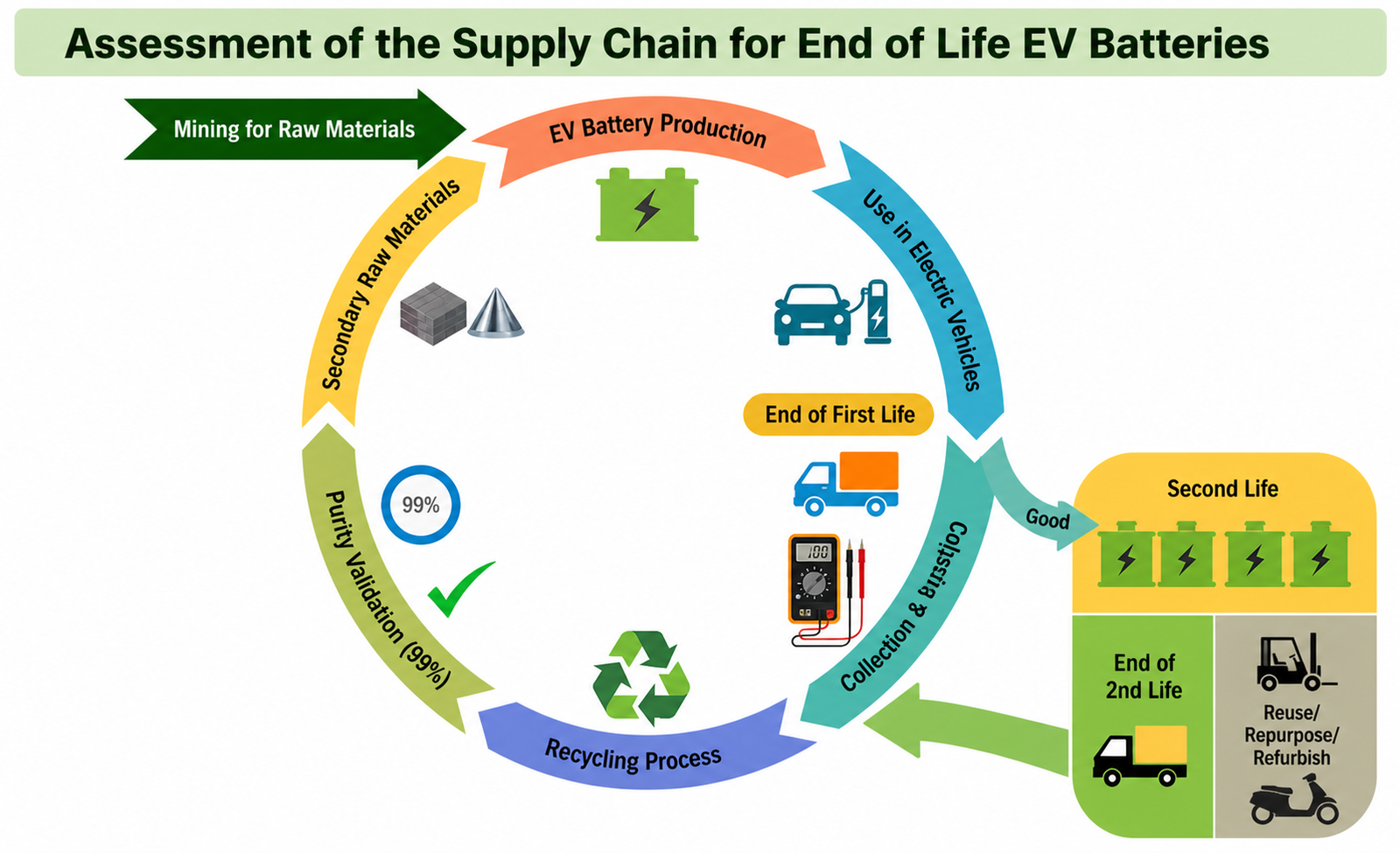
From raw materials and battery production through collection, reuse and material recovery, every stage supports a more circular EV battery ecosystem.
Batteries that are not suitable for second life are safely processed to recover usable materials.
The concentrated material stream used for further recovery.
Feeds into specialised recovery pathways
Material Recovery
Toxic Emissions
Traceability
Made in Maharashtra
Share your requirements and be part of India's circular battery economy.
At/Po-Ainapur, Taluka-Gadhinglaj
District-Kolhapur,
Maharashtra - 416526